

Eldora Speedway
‘Dirty air’ unseen, but it can make mess at Big E
By Bryan Ault
Special to DirtonDirt
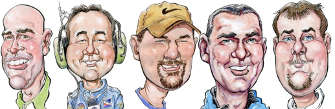
Dirty air affects cars everywhere, and especially Eldora. (joshjamesartwork.com)
ROSSBURG, Ohio (June 4) — In today’s modern Dirt Late Model world, drivers talk about the need for “clean air” and the perils of “dirty air,” yet when asked how it feels in the car, most drivers struggle to come up with an explanation. Fans are left wondering what happens when a driver suddenly tightens up and stalls after getting passed in the lower grooves, or gets loose while running on the high side without contact from another competitor. | Complete Dream coverage
The importance of finding clean air — and staying in it — is made more complicated at Eldora Speedway, a track where dirty air’s effects are magnified. Clean air is at a premium at Tony Stewart’s half-mile, high-banked track in the western Ohio cornfields, where speeds are high and decisions need to be made quicker than perhaps any other track in the country.
“It'd be nice if we could see air, right?” Bobby Pierce of Oakwood, Ill. quipped with a smile ahead of the FloRacing Night in America event at Eldora Speedway in Rossburg, Ohio ahead of the Dirt Late Model Dream weekend. “But, definitely, you know, with all the experience I've got, racing Late Models and racing here as well and other big tracks, I kind of by now know before the car does what it's going to do. I know what's going to happen if I put myself in a certain situation.”
What happens when a driver is in dirty air? Pierce, the 29-year-old superstar who has won the World 100 twice and finished second to Jonathan Davenport of Blairsville, Ga. at last year’s Dream finale, likened it to feeling as if the car “pops a wheelie.”
Brandon Sheppard of New Berlin, Ill., who finished fourth in the FloRacing Night in America event in a race won by Nick Hoffman of Mooresville, N.C., explained it best.
“You kind of know when your right front tire’s loaded, when your front end’s down on the ground, and your rear end’s up, your car's loaded in the right position, when you lose the air off your nose or somebody's air that's in front of you, however you want to say it, it's almost like your front end just feels like it's kind of taken flight, you know what I mean?” the 33-year-old driver of the Rocket Chassis House Car said. “Like, it feels like your front end just totally loses grip with the ground, and starts to come up in the air.”
There are also distinctions from becoming aero-tight or aero-loose. Pierce says becoming “aero-tight” occurs when “the air's not on the front of your car, and so when (the air’s) not on the front of your car, you don't have any weight pushing down on the front tires. And so, you can't steer, so you get tight.”
Hudson O’Neal of Martinsville, Ind. said becoming “aero-loose” feels like driving an automobile driving down an asphalt road and then moving to a gravel road in a split-second.
“If you’re running down a paved road and you turn, you're stuck pretty good, you can steer pretty good,” O’Neal said. “Well, if you're running 50 (mph) and turn on a gravel road, you're not going to steer. It just feels like it just picks the whole race car up and you go sliding.”
Regardless of whether a driver becomes aero-tight or aero-loose, according to Sheppard — who captured the 2019 Dream in the Rocket Chassis house car — one of two split-second decisions need to be made in that moment where a driver’s control of the car is compromised.
“You either hurry up and stab the brakes and get your car back loaded or stay in the gas and let it take your nose where you want to go and drive get out of it one way or another as fast as you can,” Sheppard said.
Mostly, Sheppard says, a driver has to avoid putting himself in a position where air can travel across the nosepiece and behind the car to the rear spoiler, causing the car to lose handling and drivers to lose precious seconds.
That’s difficult to do in lapped traffic, surrounded by competitors and going at high speeds.
“I mean, ideally, you want to keep your nosepiece just to the left of the guy in front of you,” Sheppard said. “That's the only safe place on the track (while in traffic). When you run up on lapped traffic, it depends a lot on where the guy's running out from. If the guy's running middle-high in front of you, you want to keep your nose left of them. If you're running the bottom and that guy's running the bottom, you don't want to drive into the corner in the bottom, running your lane. If you're gonna follow that guy in there, you’ve got to make sure that your nose is to the left, clear of him, or else you're gonna catch that dirty air and fly right across the track.”
The best place to be in avoiding dirty air, of course, is in the lead (at least until reaching lapped traffic). And O’Neal, the 25-year-old who took home the checkered flag at the track’s World 100 in 2023, has plenty of experience racing in the front of the pack.
“He's running his own race,” O’Neal said of the leader. “It doesn't have to be where you're running 10th behind a bunch of race cars. It can be just one car out in front of you that messes it up. And if anybody pays attention to lap times whenever the leader catches lapped traffic, you can watch the pace slow way down. It's not the driver's slowing down. It's the air slowing them down, you know?”
Pierce said dirty air can be detected as far as six lengths away because of the wide-bodied nosepiece of the modern machines. Dirty air can sometimes be felt on the same straightaway at Eldora, where speeds are high. A driver exiting turn two can feel it from a driver in the middle of turns three and four.
“That's plenty enough for them to mess up your air,” Pierce added. “When you're catching somebody, the closer you get to them, the slower your lap times are going to be. It really doesn't matter where on the track, if it's bottom, middle-top, we're going fast enough here that even if we run the bottom of the track, we're going so fast. The air is highly dependent. Like, we use it. So there's no (safe) spot on the track. It's just wherever they're not.”
While fans and even drivers think the aero-dependency of the modern machines can be a nuisance, O’Neal sees the battle for clean air as a positive. Even though it can be a battle for drivers to face, he thinks it makes racing in packs more entertaining than it otherwise would be.
“The air will be a factor in our racing for eternity because we can't unlearn what we've already learned,” O’Neal said. “You know, you can't make a scientist learn something new, you can't take that knowledge out of his bank, so no matter what they try to do to the bodies, we're going to face that problem for the rest of our lives.”
“It makes racing fun because the knowledge, you know, our elders, that's what separates him on places like this,” he added. “You look at the guy standing beside you, Dale McDowell, you know, Jonathan Davenport, Scott Bloomquist, all those elders that have been racing a long time, they understand the air. It's a really cool aspect of our thing. People talk about it negatively, but it's actually probably an aspect that helps racing.”





.webp?v=2.0.6)